Orchard Hill English Shepherds
TRAINING page 3
Our cattle work on the ranch is sporadic, so the dogs aren't able to learn by following a routine. We bring the cattle in to the corral several
times a year for vaccinating, weaning, and sorting for sale. Between those times, they live in our canyon pasture, over 300 acres in size.
Mace's first official gathering job was to help me bring the cows from the bottom of the canyon, up over the ridge and down to the corral.
These cows weren't dog-broke. Typically, they would dodge around me, and head deeper into the canyon, rather than go up the hill. Were
they in for a surprise this time! We got them started, and moved them along until they spotted a break in the brush, and a side trail that
headed down to the creek. Several of them headed for the break in the brush, and I yelled at them, waving my arms. This is when they
USED to dodge around me and head for the creek, thumbing their noses at me. This time, Mace took his cue from me, and was
immediately in their faces. I had not said anything to him, but an English shepherd is very much in tune to helping its owner. Instead of a
slow human, they met a snarling, snapping, darting, agile, fast, in-their-faces English shepherd! They decided it was easier to stay on the
trail to the corral. The rest of the gather went smoothly, and we were finished with the job much earlier than usual.
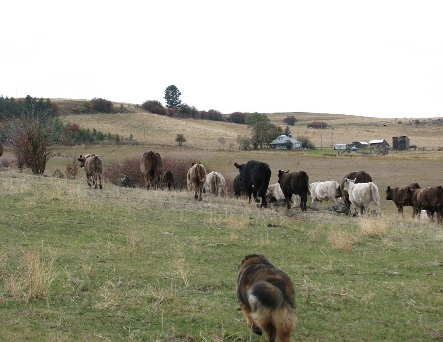
Here, Mace and I are moving the cattle down to the
corral, just over the hill. I have Mace on a long line.
After dog-breaking these cows, Mace was inclined to
continue being more assertive with them than they
needed. I used the long line to help him tone things
down. At this stage in the day, he had learned to work
quietly, and was just dragging the line. I have found
the cattle are much more cooperative when Mace or
Ember is along. They tend to stay bunched up and
don't try to turn back or dodge the wrong way.
I was looking for opportunities to take Mace to a cattle clinic. Cattle work is so different from sheep work, that I wanted to work Mace
under a professional eye, using calm, quiet cattle. Two opportunities presented themselves. A two-day cattle clinic with Larry Painter,
from Missouri, was offered at Brigand's Hideout in western Washington. A local clinic with Tom Blasdell, from Prineville, OR, offered both
cattle and sheep work. We went to both of them!
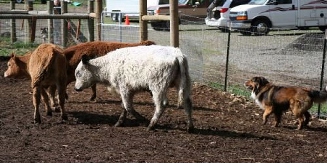
March, 2007. Mace is one-and-a-half years old. Here, he is
practicing taking the calves off the fence at the Larry Painter
clinic. He was learning to stay out along the fence to keep
them bunched up and under control. This pen was about 75'
by 75'. He started out on a long line, to guide him along the
fence and through the corners correctly. Once he understood
what was expected of him, he graduated to off-line work like
this. I was pleased with his calm work.
A couple of months later, Tom Blasdell was near Grangeville for a clinic. Mace worked on controlling cattle as they moved along a
fence, turning them one direction, then the other.
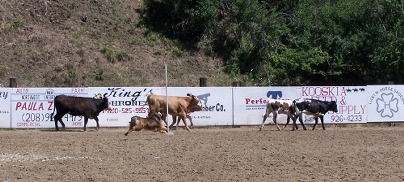
Mace is racing to the head of these calves to stop them
and turn them back to the left. Working along a fence like
this limits the options the cattle have for escaping,
making Mace's job easier, and he can learn his job a
little faster.
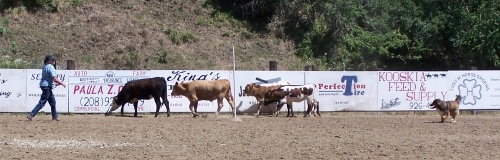
Here, they have turned back, and Mace is
turning out and starting back toward their
heads. He will turn them again, working them
back and forth along the fence.